Motorhome Payload Explained: What You Need to Know Before You Travel
Your motorhome payload is the total weight you can safely add to the vehicle without exceeding its legal maximum weight. It must account for passengers, luggage, water, gas bottles, food, accessories and anything else carried inside or fitted to the motorhome.
To calculate the stated payload, subtract the motorhome’s Mass in Running Order (MIRO) from its Maximum Technically Permissible Laden Mass (MTPLM). However, the most reliable way to check your remaining payload is to load the motorhome as you would for a trip and take it to a public weighbridge.
What Is Motorhome Payload?
Motorhome payload is the amount of weight that can be added to a motorhome before it reaches its maximum permitted weight.
You will usually encounter two important figures:
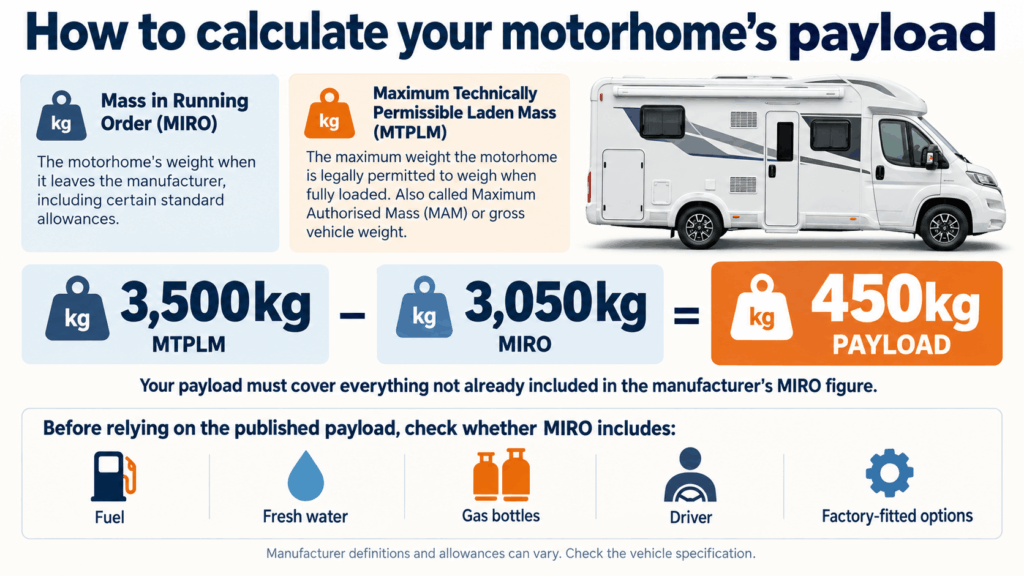
- Mass in Running Order (MIRO): The motorhome’s weight when it leaves the manufacturer, including certain standard allowances.
- Maximum Technically Permissible Laden Mass (MTPLM): The maximum weight the motorhome is legally permitted to weigh when fully loaded. This may also be described as the Maximum Authorised Mass (MAM) or gross vehicle weight. GOV.UK explains how vehicle weighing is used to check compliance with maximum permitted weight limits in its weighing vehicles for enforcement guidance.
The difference between these figures is the motorhome’s stated payload.
For example:
3,500kg MTPLM – 3,050kg MIRO = 450kg payload
That 450kg must cover everything not already included within the manufacturer’s MIRO figure.
Manufacturers can use slightly different definitions and allowances when stating MIRO. Before relying on a published payload figure, check the vehicle’s specification to see whether it includes fuel, fresh water, gas bottles, the driver or factory-fitted options.
Why Does Motorhome Payload Matter?
Understanding payload helps you choose a motorhome that is suitable for how you intend to use it.
A couple travelling lightly for occasional weekends may need considerably less payload than a family preparing for a two-week tour. Bikes, outdoor furniture, food, clothing and a full fresh-water tank can quickly use more capacity than expected.
Exceeding the vehicle’s permitted weight can affect:
- Braking distances
- Steering and handling
- Tyre performance
- Fuel consumption
- Insurance cover
- Compliance with UK and overseas road laws
Your motorhome must remain within both its total permitted weight and its individual front and rear axle limits. It is possible for the overall weight to be legal while one axle is overloaded.
Payload should be considered before buying rather than treated as something to work out afterwards. Our ultimate motorhome buying guide covers the other important decisions to make when comparing vehicles.
Common Motorhome Payload Mistakes
Assuming the published payload is all available
The stated payload may not account for optional equipment fitted to the motorhome. An awning, additional leisure battery, solar panel, satellite system, bike rack or upgraded furniture can reduce the remaining allowance.
Forgetting passengers
Passengers form part of the payload unless they are specifically included in the MIRO calculation. Their clothing and personal belongings must also be counted.
Travelling with unnecessary water
Fresh water is heavy, with one litre weighing approximately one kilogram. Carrying 100 litres of water therefore adds roughly 100kg to the vehicle.
You may prefer to travel with only the water needed for the journey and refill at your destination, where suitable facilities are available.
Ignoring axle limits
A motorhome can be below its overall MTPLM but still exceed the maximum weight allowed on one axle. Rear garages, bike racks and heavy equipment positioned towards the back of the vehicle can place considerable pressure on the rear axle.
Estimating instead of weighing
Small items quickly add up. Food, bedding, electrical equipment, tools and outdoor furniture may each seem insignificant, but together they can use a large proportion of the available payload.
How to Calculate Your Motorhome Payload
Start with the basic calculation:
MTPLM – MIRO = stated payload
You should then subtract the weight of anything that is not included in the MIRO figure.
As an example, imagine a motorhome has:
- An MTPLM of 3,500kg
- A MIRO of 3,050kg
- A stated payload of 450kg
You might then add:
- Passenger: 75kg
- Water: 50kg
- Gas bottles: 25kg
- Awning and bike rack: 55kg
- Two bikes: 40kg
- Food, clothing and equipment: 100kg
This produces an additional load of 345kg, leaving approximately 105kg of the stated payload available.
This calculation is useful for planning, but weighing the motorhome provides a more dependable answer. Load it as it would normally be used, including passengers, fuel, water, gas, luggage and equipment, before visiting a public weighbridge.
Where possible, check the total vehicle weight and the weight carried by each axle. Compare the results with the limits on the vehicle’s weight plate, and retain the weighbridge ticket for your records.
If the motorhome is too heavy, remove non-essential items, reduce the amount of water carried or reconsider how the load is distributed. Some vehicles may be eligible for uprating, but this depends on their technical specification and may also change the driving licence entitlement required.
When comparing our new motorhomes and approved used motorhomes, speak to our team about your passengers, equipment and usual touring plans. We can help you assess whether a vehicle offers a practical payload for your needs.
Frequently Asked Questions
Some MIRO calculations include an allowance for the driver, while others may use different assumptions. Check the manufacturer’s specification rather than presuming the driver has already been accounted for.
The Maximum Authorised Mass is normally shown on a plate or sticker fitted to the vehicle. It may also be listed in the owner’s manual or vehicle documentation.
You can use a public weighbridge. Contact the operator before visiting to confirm its opening hours, cost and whether it can provide separate axle measurements.
You can find your nearest public weighbridge using the GOV.UK find a weighbridge service. Enter your postcode or town to locate nearby sites, then contact the operator before visiting to check opening hours, charges and whether axle weights can be measured separately.
